Off Charles Bancroft Highway in Litchfield, a farm is quietly becoming a condominium complex. Corning Farm Condominium is currently in its second of four planned phases, with finished units already occupied and others still waiting for buyers to pick their finishes. It is a useful thing to watch, because it shows what actually has to happen before Litchfield's open land turns into a driveway and a foundation. Farmland does not become buildable just because someone wants to build on it. It has to be pulled out of a specific state tax program first, and that process leaves a paper trail at the registry of deeds.
Most buyers looking at a big-lot listing in Litchfield never think about that trail. They see "2.13 acres" or "5 acres" in the listing description and assume it means what it would mean almost anywhere else: more yard, more privacy, more room to eventually add a pool or a barn. In Litchfield, that assumption is worth checking before you write an offer.
The Acre You Think You're Buying
Land in Litchfield is not cheap right now. As of this summer, houses listed with acreage in town were averaging roughly $759,633, which works out to about $357,194 per acre once you factor in the land itself. That is a meaningful premium over a standard subdivision lot, and it is the number that makes big parcels feel like the smart buy: more land per dollar than you would get closer to Manchester or Nashua.
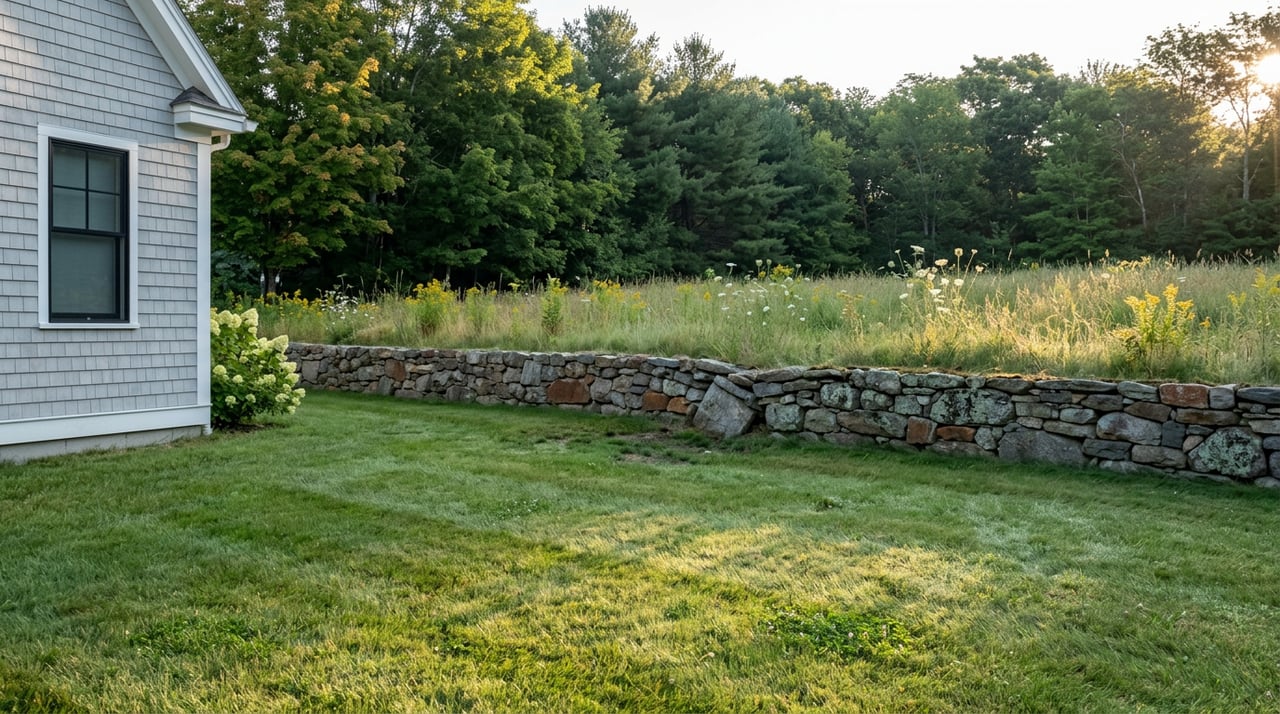
But that per-acre price assumes the acreage is yours to use. A lot of Litchfield's "extra" acreage is not. Some of it is farmland or forest still enrolled in New Hampshire's current use program under RSA 79-A, a state law that taxes qualifying open land at its income-producing value instead of its market value, in exchange for the owner agreeing not to develop it. The enrollment does not expire when the property sells. It rides along with the deed. A buyer can close on a house with a beautiful open field behind it and not realize that field is legally restricted until they call the town about a shed permit.
Litchfield Grows Farms, Not Forests
Here is the part that makes Litchfield different from most of the state. New Hampshire's current use program is dominated by forest. Statewide, forest land makes up roughly 86 percent of all current use acreage, with farmland accounting for less than 7 percent. Litchfield runs almost the opposite way. According to the town's own Master Plan, farmland makes up nearly a third of all current use acreage in Litchfield, with forest at about half. That is a very different mix from the state as a whole, and it did not happen by accident.
Litchfield developed as a narrow strip of farms and mills running along the Merrimack River and Route 3A, and the town's history explicitly credits a 1970s decision to build Albuquerque Avenue as a second north-south road specifically to steer growth away from Route 3A's prime farmland. The town chose to protect its farm ground rather than let it get carved up as the main commercial corridor developed. Decades later, that choice shows up as an unusually high share of farmland still sitting in current use, quietly zoned by tax status rather than by fence line.
For a buyer, the practical effect is that a big Litchfield lot is more likely than a comparable lot in a heavily forested NH town to include working or formerly working farmland still under a current use agreement. That land often looks the most inviting on a listing photo: open, mowed, sunny. It is also the land most likely to carry restrictions a buyer does not expect.
What Current Use Actually Locks Up
Current use is not a secret or a defect. It is a well-established New Hampshire tax program, and more than half the land in the state is enrolled in it. According to UNH Extension, a parcel generally needs to be at least 10 acres of qualifying farm, forest, or unproductive land to qualify, though smaller farm parcels can qualify if they produce at least $2,500 a year in agricultural products. Landowners apply through their town by April 15 each year, and Peterborough's Assessing Department says the enrollment is recorded at the county registry of deeds as a notice of contingent lien, a public record that puts every future owner on notice.
That last part matters most for buyers. The lien does not go away at closing. There is no buyout provision under state law that lets a new owner simply pay a fee to lift the restriction on day one. The land stays in current use, taxed at its lower agricultural or forest value, until someone physically changes how it is used, whether that is the seller who enrolled it decades ago or the buyer who closes on it next month.
The Bill That Arrives When You Build
The moment qualifying land is disturbed, the town assesses a Land Use Change Tax. It is a one-time charge equal to 10 percent of the full market value of the specific portion of land that changed, not the discounted current use value, and not the whole parcel if only part of it is affected. The rest of the property can remain in current use if it still meets the acreage minimum.
To see why this matters in Litchfield specifically, run the math with the town's own land values. At an average of roughly $357,194 per acre, converting even two acres out of current use for a new driveway, addition, or backyard pool could mean a full market valuation near $714,000 for that slice of land, and a Land Use Change Tax bill in the neighborhood of $71,000. That is an estimate built from Litchfield's current per-acre benchmarks, not a quote from an assessor, and actual figures depend on how the town values the specific parcel at the time of the change. But the order of magnitude is the point. On land priced the way Litchfield's is priced today, this is not a paperwork fee. It is a bill large enough to change the math on why a buyer wanted the extra acreage in the first place.
There is one piece of good news buried in the statute. The Land Use Change Tax is the only penalty. New Hampshire does not also claw back years of prior tax savings once the change is made. The bill is one-time, based on the value of the land at the moment it changes, and nothing more.
Before You Assume You Can Expand
If you are looking at a Litchfield listing with more acreage than the house alone seems to need, a few questions are worth asking before you write an offer that assumes you can use all of it:
- Ask the listing agent or seller directly whether any portion of the parcel is enrolled in current use, and if so, how much acreage and under what classification.
- Check with the Litchfield Assessing Department whether a notice of contingent lien is recorded against the property at the Hillsborough County Registry of Deeds.
- If you plan to build, expand, or clear any part of the lot, ask what the town would consider the "full market value" of that specific portion today, since that number drives the one-time tax, not the home's overall sale price.
- Remember that The Timberland Investor says subdividing land alone does not automatically trigger the tax.
None of this makes a big-lot Litchfield property a bad buy. It just means the acreage number on the listing sheet is a starting point for a conversation, not a finished answer about what you are actually getting for your money.
A Couple Questions Worth Asking
Does current use status show up automatically in a home inspection? No. A standard home inspection covers the structure and systems, not land use classification. Current use enrollment is a matter of town assessing records and the registry of deeds, which is why it is worth a direct question to the seller's agent and a quick call to the assessor's office rather than something you can expect to surface on its own.
If I buy land in current use and never touch it, do I owe anything? No. The Land Use Change Tax is triggered only by an actual change in use. Land that stays untouched, farmed, forested, or simply left open, continues to be taxed at its current use value indefinitely, regardless of who owns it.
If you are weighing a big-lot property in Litchfield against something more compact closer to Manchester, the acreage on the listing is only half the story. The other half is what that acreage is legally allowed to become, and that is exactly the kind of local detail worth working through with someone who knows the town before you write an offer. Chris Pascoe has spent years walking these lots and these town records with buyers who wanted the full picture, not just the square footage. Reach out and get a straight answer on what a specific Litchfield property's acreage actually means for you.
This article is general information, not legal, tax or financial advice. Consult a qualified professional about your situation.